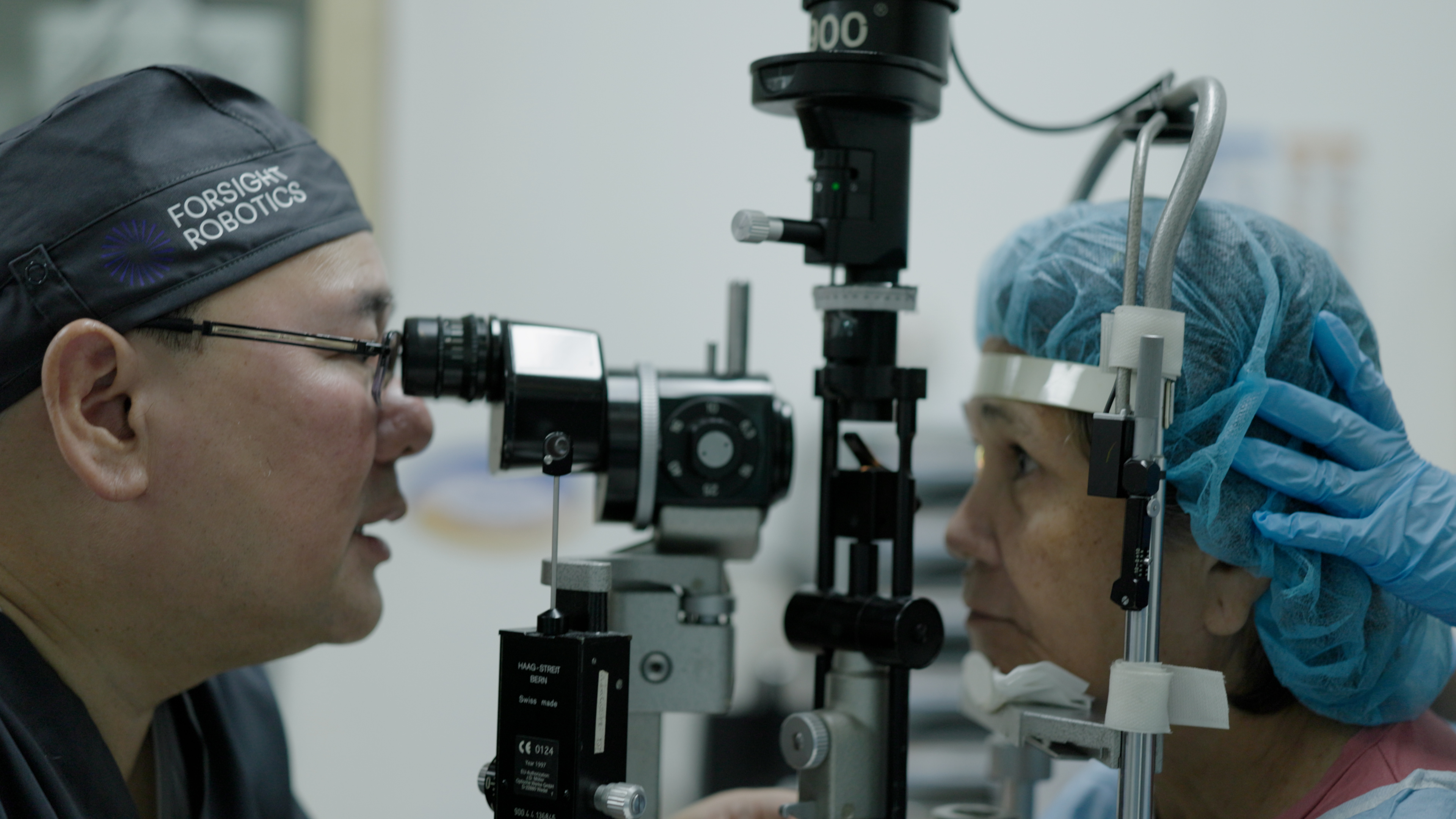
A surgical video can show us what happened. A clinical record can tell us how a patient recovered. But understanding the relationship between a surgeon’s decisions, the movements of an instrument, and the eventual outcome requires a connection between information and action.
At ForSight Robotics, we believe this connection will define the next era of ophthalmic surgery. Our ambition is to build a physical foundation through which surgical expertise can become more measurable, more transferable, and ultimately more accessible.
The opportunity broader than digitizing surgery. It is about creating a better way to learn from it and translating that learning into better care.
Intelligence Needs a Way to Act
In surgery, understanding the clinical situation and executing an intervention are different challenges. A model may identify an anatomical structure or suggest an approach, but that does not give it the ability to manipulate an instrument safely within the eye.
This is why the physical component of Physical AI matters.
For surgical intelligence to influence an intervention, it needs a platform capable of translating instructions into controlled movement, while providing meaningful feedback about what actually occurred.
Research is beginning to demonstrate the potential of learning surgical actions from robotic demonstrations. The SRT-H research program, for example, demonstrated learned surgical capabilities in ex-vivo experiments. Those results are not evidence of readiness for autonomous human surgery, but they illustrate an important direction: connecting observation with physical execution.
For us, the implication is clear. The path toward increasingly intelligent surgery starts with purpose-built robotics, not with an algorithm alone.
Why Start with Sight?
The purpose of this technology must begin with the patient.
The World Health Organization estimates that one in two people globally who need cataract surgery cannot access it. This is not a problem that better software alone can solve. It is a challenge of delivering care.
We believe ophthalmic robotics can become part of that solution. But it will only make a meaningful impact if it helps surgeons, fits clinical workflows, and makes economic sense for the institutions delivering treatment.
That is the standard against which innovation should be judged. An impressive demonstration is a beginning, while technology that can help more patients receive high-quality care is the goal.
From an Isolated Task to the Complete Procedure
At ForSight, we are developing JASPER™ to support the complete cataract procedure, with the surgeon directing the instruments throughout. Its architecture brings together two robotic arms, three-dimensional visualization, eye tracking, and scaled instrument movement.
The importance of this approach extends beyond any individual movement.
A procedure is a sequence of decisions and actions. An adjustment in one phase may influence what becomes possible, or necessary, in the next. Studying an isolated step can provide useful information, but understanding the broader sequence offers a different opportunity.
A platform involved throughout the procedure could provide a more continuous view of surgical execution: the intended movement, the actual trajectory, the visual context, and the surgeon’s response as conditions change.
The Most Valuable Data Connects Decisions to Outcomes
Imagine being able to connect a patient’s preoperative measurements and surgical plan with synchronized records of instrument movement, procedural events, and postoperative results. Researchers could investigate not only whether an operation achieved its objective, but which aspects of execution were associated with that result.
Did a particular movement pattern matter? Did a correction improve the course of the procedure? Does information recorded during surgery add predictive value beyond what was already known before the operation?
A useful learning system must account for differences in patients, surgeons, anatomy, and case complexity. It must also preserve the difficult moments (the adjustments, interruptions, and recoveries) not just the smoothest examples.
A Learning System, Not a Self-Governing Operating Room
There is an important caveat when it comes to physical AI in the operating room: The ability to learn from procedures must not be confused with permission to change clinical behavior automatically. Our vision is a disciplined cycle: collect appropriately governed information, identify a potential improvement, evaluate it, validate it, and only then introduce it through the applicable clinical and regulatory processes. The FDA’s framework for predetermined change control plans reflects this distinction. It supports specified modifications to AI-enabled devices through defined development, validation, and implementation methods.
The first useful applications may be less dramatic than autonomy: better training, more informative case review, improved planning, or assistance with a carefully defined task. That does not make them less important. A capability that reliably helps a surgeon is more valuable than an ambitious label without evidence behind it.
A New Source of Value in Surgical Technology
I believe this approach could change how value is created in surgical technology.
A robotic platform can provide physical capabilities. A well-designed data architecture could help us understand their use. Validated software could then translate that understanding into additional benefits for surgeons and patients. These elements should reinforce one another.
But the business case must remain grounded in utility. Data should not become an end in itself, and patients should never be reduced to a source of information.
For providers, the relevant question is whether a capability improves care delivery, training, workflow, or resource use. For surgeons, it is whether the system helps them perform their work. For patients, it is whether the technology contributes to a better experience and meaningful clinical outcomes.
The same principle applies to partnerships. Building this future will require collaboration among surgeons, institutions, technology companies, and researchers, with clear responsibilities for privacy, permitted data use, and the development of resulting capabilities.
Scaling Expertise, Not Replacing It
Our vision of Physical AI begins with respect for the surgeon.
The aim is not to remove clinical judgment from surgery. It is to give that judgment better tools and, over time, find responsible ways for the knowledge gained through surgical practice to benefit more people. ForSight’s ambition is to build the physical foundation for that future in ophthalmology: a platform that connects what a surgeon sees, what the surgeon does, and what ultimately matters to the patient.
Success will not be measured by the volume of data collected or the sophistication of an AI model. It will be measured by whether we can elevate the standard of surgical eye care at scale.
That is why we are building ForSight.
For all to see.
Joseph Nathan, MD, MSc is the Co-Founder and CEO of ForSight Robotics
JASPER™ remains under development and is not yet approved for commercial use. The future AI-enabled capabilities discussed here describe a development vision, not currently established clinical functionality.