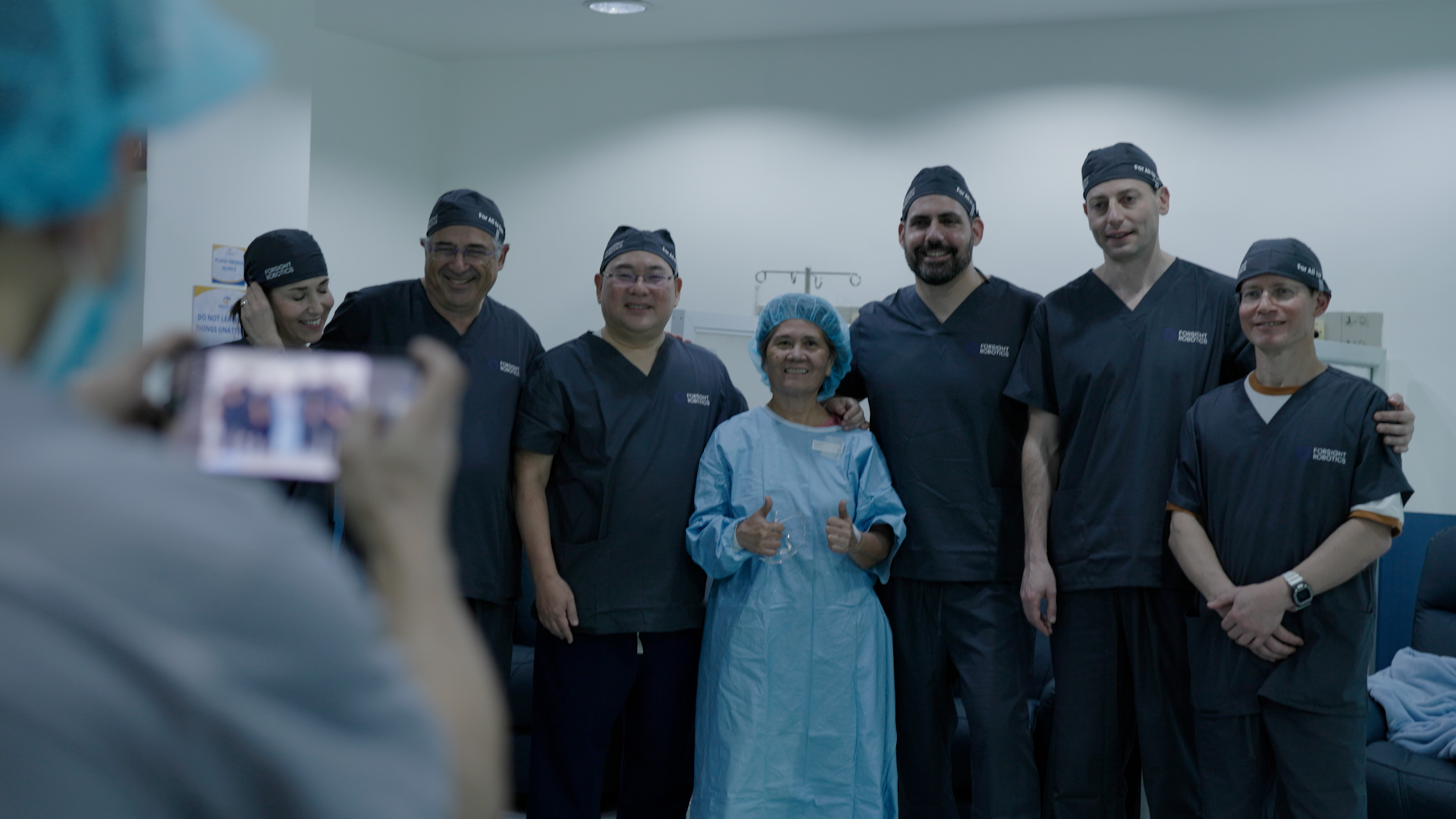
Standing in the operating room in Manila, watching the surgeon guide ForSight’s robotic system through the delicate steps of a complete cataract surgery, the room felt electric. There was an unmistakable sense that we were witnessing a turning point in medicine.
That day, we completed the world’s first fully robot-assisted, in-human cataract surgery using our JASPER™ platform. Beyond being a stunning technical achievement, it was fundamentally human. Because at its core, this is not about machines performing surgery, it is about enabling more people, everywhere, to receive the level of care that until now depended on geography, access, and individual skill.
Cataract surgery is one of the most impactful procedures in medicine, capable of restoring sight and transforming lives. Yet for millions, it remains out of reach, and for many others, outcomes still depend on where they live and who performs the procedure. When you hear a patient describe living with diminishing vision, you’re reminded of the true ‘why’: restoring independence, dignity, and connection to the world, while raising the standard of care and making high-quality eye surgery accessible to all.
From the beginning, when we founded ForSight Robotics in 2020, we asked a simple question: What if, using robotics, AI, and advanced visualization, we could rethink how eye surgery is delivered?
What we saw in that operating room in Manila was the first real answer to that question. With JASPER™, our Surgical Proctor Dr. Alexey Rapoport and Principal Investigator Dr. Robert Ang, completed entire cataract procedures without touching a single surgical instrument. They proved that fully robot-assisted cataract surgery is possible, in a real clinical setting and within the normal standard of care.
In that moment, my co-founder Dr. Daniel Glozman and I were overwhelmed by pride in the technology and by gratitude for the people who made it possible: Our incredible team, who spent years pushing the technological boundaries. Our host and institution, Dr. Ang of The Asian Eye Institute in the Philippines, who was a true partner during the entire clinical trial. And the patients, who placed their trust and confidence in something entirely new.
Milestones like this are never the result of a single breakthrough. They are the accumulation of thousands of small decisions, late nights, and moments of sheer belief that what we set out to accomplish could be done.
This one also came during a time of uncertainty. As geopolitical events unfolded in the region and we were once again at war, our team faced unexpected challenges and delays getting back to their homes and families. And yet, through it all, there was a shared sense of purpose that never wavered.
On a personal level, the timing carried its own weight. Just days before I travelled to The Philippines, my wife and I welcomed our third child. The journey from one operating room to another, one filled with the arrival of new life, the other with the promise of restored sight, made it unmistakably clear that robotics enable the work, but people are why it matters.
The procedures we performed in Manila were historical firsts. They also marked the beginning of something much larger: a critical step in the path toward making the future of high-quality eye surgery more consistent, scalable, and accessible. The path toward reducing the variability that defines so much of surgical care today. And ultimately, the beginning of a new standard in surgery, where the quality of care is no longer defined by where you are or who performs the procedure, but by what is possible.